EPIcentre Computer Monitor
Lineup Charts
WHAT YOU SEE - IS IT REALLY WHAT YOU
GET?
Although we spend a great deal of time
configuring our computers, it's a sad fact that most
computer monitors are not adjusted to view all the detail in
the images displayed upon them. This is hardly surprising
when computer manuals ignore this important area, leaving
users to set Brightness and Contrast using
nothing more than guesstimation. Correct monitor adjustment
is a neglected area of computer setup.
In the world of wordprocessing,
spreadsheets and colourful graphics all that matters is that
images are punchy and colourful. But in the world of digital
imaging, with photographic quality images, a correctly set
up monitor is essential for serious work.
People get frightened by colour WYSIWYG -
what you see is what (you hope) you get - having been led to
believe that the only way to get it right is to throw money
at the "problem". Fortunately, that's not so.
IT'S FREE!
The good news is, you already have most
of the solution, free. Your eyes and common sense are all
that is needed, together with some thought and a logical
approach.
This section contains everything required
to carry out a basic set-up of your computer's colour
monitor and printer. The techniques outlined here will get
you 95% of the way to lining-up your system to perfection.
Gnawing away at the other 5% could cost you a lot of money.
And you have to face the fact that you can never achieve
100% fidelity.
HOW DO YOU VIEW?
The first thing to pay attention to is
your working environment - your computer's Desktop Pattern
and the ambient light in which you work.
SETTING THE DESKTOPS
If you use an Apple Macintosh computer
you have a utility called "Desktop Pictures" in your
"Control Panels" folder, which is in turn inside the "System
Folder" on your hard disk.
Open this Control Panel and select the
1-bit Gray desktop pattern now (it's pattern 47 in
the list). Alternatively, select Silver accent
(pattern 10 in the list) which is also neutral. Click "Set
Desktop Pattern". Close the Control Panel.
On no account should you select a
coloured desktop pattern - they are there only to
brighten the mundane lives of unfortunate people who have to
spend their entire lives looking at spreadsheets. In digital
imaging, a brightly coloured desktop is a sure sign of
someone who doesn't understand what he or she is doing.
You have been warned!
If you choose to ignore this advice and
select a coloured desktop, your eyes will be assaulted and
desensitised by the colour you choose. All images you judge
against it will appear to be lacking in its colour. For
example, if you choose the magenta desktop (and who in their
right mind would?) all images you view against it will
appear green, forcing you to add magenta to make them look
right. But when someone views your images against a grey
background, they will have a magenta bias.
If you really want something other than a
flat grey desktop, at least use a neutral one. The
background we use at this Website is textured but -
importantly when viewing images - the greys in it are
neutral.
So let's get it right from the start. A
grey desktop is a clear indication of a knowledgable digital
imager.
THE RIGHT FURNITURE
The same also holds for the desktop on
which your workstation sits.
Buy a neutral grey desk or table if you
can. Make sure it's grey by taking along a Kodak Grey Card
and laying it on the desktop in the showroom. (Kodak Grey
Cards are available at all good photographic stores.) The
desk you buy doesn't have to be the same tone (18%) but it
should be neutral grey - the card will help you spot whether
the desk's grey has some colour in it.
I have nice wooden tables from Ikea.
They're strong and not as expensive as "bespoke" computer
furniture. But the natural wood is not what I want to bias
my eyes with, so I use grey plastic desktop mats (also from
Ikea) to keep my eyes "calibrated". They also work well as
large (70 x 40 cm or 27.5 x 15.5 inches) mouse
mats.
WORKING LIGHT
It's bad practice to illuminate your work
area with fluorescent lights - unless you are certain that
the tubes you are using are special photographic-quality
daylight balanced. Nor is it a good idea to work in natural
daylight, switching on the incandescent room lights when
dusk falls.
The light you use to light your work area
is particularly important. What you should have is a work
area with carefully controlled illumination, falling on the
. This need not be expensive. I use a small tungsten-halogen
spotlight with a colour temperature of 3200K (actually, it's
just under this). On it I use Lee Filters' "Half CTB"
(Colour Temperature Blue) lighting filter to raise the
colour temperature to mid way between tungsten (3200K) and
daylight (about 5500K). After years of experimentation, I
have found that I prefer this mid-way solution. Examine the
colour filter at regular intervals and change it if it
begins to fade.
SET UP YOUR MONITOR'S GAMMA
Next set up your monitor's gamma using
the Gamma utility which comes with Adobe
Photoshop.
You will probably find this file hiding
in Photoshop's "Calibration folder". Move it to the "Control
Panels" folder, restart your computer, and then open
Gamma.
Click the "On" button to make Gamma
active. "Target gamma" should probably be 1.8, though some
monitors may need one of the other Target Gammas. Find out
by experimentation - you can't do any damage. Click the
radio button to select this. Then, looking at the bar of
alternating grey boxes just above it, drag the Gamma
Adjustment triangle to the left and right until the
alternating greys all look the same shade. It may help if
you half close your eyes when doing this, to blur the
patterns in the grey boxes.
When you are happy, click the "Save
Settings" and save your settings in a file, in case you need
to re-load them in the future. Then click at the top left to
close the Gamma utility.
Need any more information? You'll find it
in your Photoshop manual.
IS YOUR MONITOR SHOWING YOU
EVERYTHING?
Now ensure that you monitor is displaying
all the 256 levels of each of the primary colours which your
computer can generate. You need a RGB mode greyscale from
black to white in 5% steps to do this. Here's one that you
can download from us. Just point at this image with your
pointing device, click and hold, then save the image. It
will be saved as a 525 x 25 pixel GIF image. Convert it to
RGB (in Photoshop, select "Mode", then "RGB Color"). This
image is a convenient size to sit at the bottom of your
monitor while working in your favourite image editing
application, providing a constant reference
greyscale.
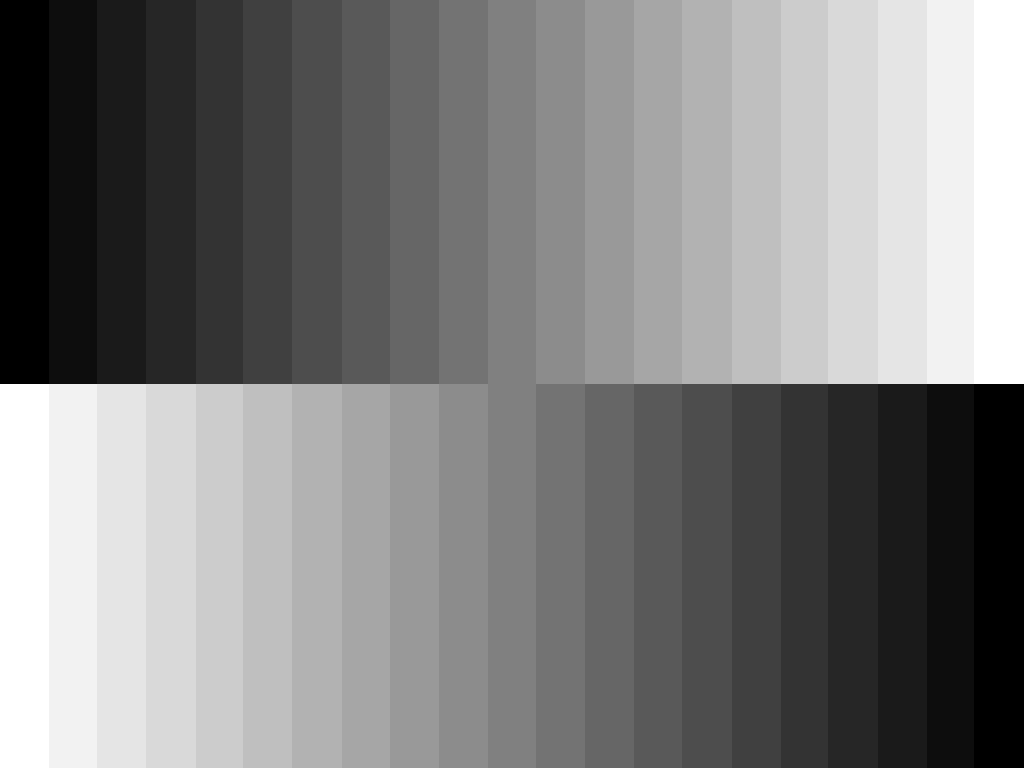
Note that there are two greyscales,
running in opposite directions. Mid grey is where the upper
and lower squares are identical tone.
With this greyscale, the monitor can be
set up using nothing more than the brightness and contrast
controls, so that you can see every one of the patches from
black through to white. It is as simple as that: your
computer cannot generate anything less than 0 (which is
black), nor more than 255 (which is white). Mid grey is 127
or 128, as near as possible to half way between 0 and
255.
You can measure the light output from
each of the patches on your monitor and plot a graph of the
monitor's gamma. I use an old SEI Photometer for
this.
GREYSCALE TRACKING
The greyscale also gives an indication of
the "grey scale tracking" of the monitor - how well it
reproduces greys by mixing together red, green and blue
light within the cathode ray tube, without introducing a
colour cast into any of them. If there is a colour cast,
this can be neutralised using the Gamma utility to adjust
the overall neutrality (Balance) and the neutrality of the
Black and White Points:
Click the appropriate radio button (the
"Balance" button is selected in the illustration) and drag
the triangles along the lines to adjust red, green or blue.
The eleven-chip greyscale in the Gamma utility helps you
judge the effect of your adjustments, all of which are
software adjustments - easy to cancel if you don't like
them.
EACH AND EVERY BIT
The next chart contains all the greys
tonal values (greys) which computers can display, together
with how many computer bits are required to describe them.
Unfortunately the 64, 128 and 256 greys will probably all
display at only 32 levels only in your browser - that's one
of the limitations of the WWW.
What you need to do is view the image
off-line in your favourite imaging package. To download,
point at the image with your pointing device, click and
hold, then save the image. It will be saved as a 502 x 124
pixel GIF image. Convert it to RGB colour (even though it is
a monochrome image - in Photoshop, select "Mode", then "RGB
Color"). Make sure that you monitor is set to "Millions" of
colours.
The "2 tonal values" are simply black and
white, achieved in computers by devoting just one bit to
each screen element. This kind of display was used in early
computers. Note that the number of tonal values doubles for
each addition bit devoted to describing each
pixel.
Displays which devote 24 bits to each
screen pixel use 8 bits per primary colour and can display
256 levels of grey, made up by mixing equal amounts of the
primaries. But 24 bit displays are able to display a
staggering 16,777,216 different colours - all the
combinations of 256 discrete levels of each of red, green
and blue - for each pixel in the image.
If you have a 24 bit monitor, the bottom
band of this image should appear as a continuous gradation
from black to white or white to black. This is what is
termed "photo-realistic": the steps are so close together
that you cannot distinguish them.
Unfortunately, CompuServe GIF format
images can only hold 256 colours. This is fine for our test
charts (which contain 256 or fewer colours) but not
sufficient for photographic quality.
COLOUR BARS AND GREY SCALE
Your computer monitor has three electron
guns which excite only their respective red, green and blue
phosphors on the inside of the face of the tube. All other
colours are made by combining these three colours in varying
amounts.
To download this image from us, point at
the image with your pointing device, click and hold, then
save the image. It will be saved as a 640 x 480 pixel GIF
image. Convert it to RGB (in Photoshop, select "Mode", then
"RGB Color").
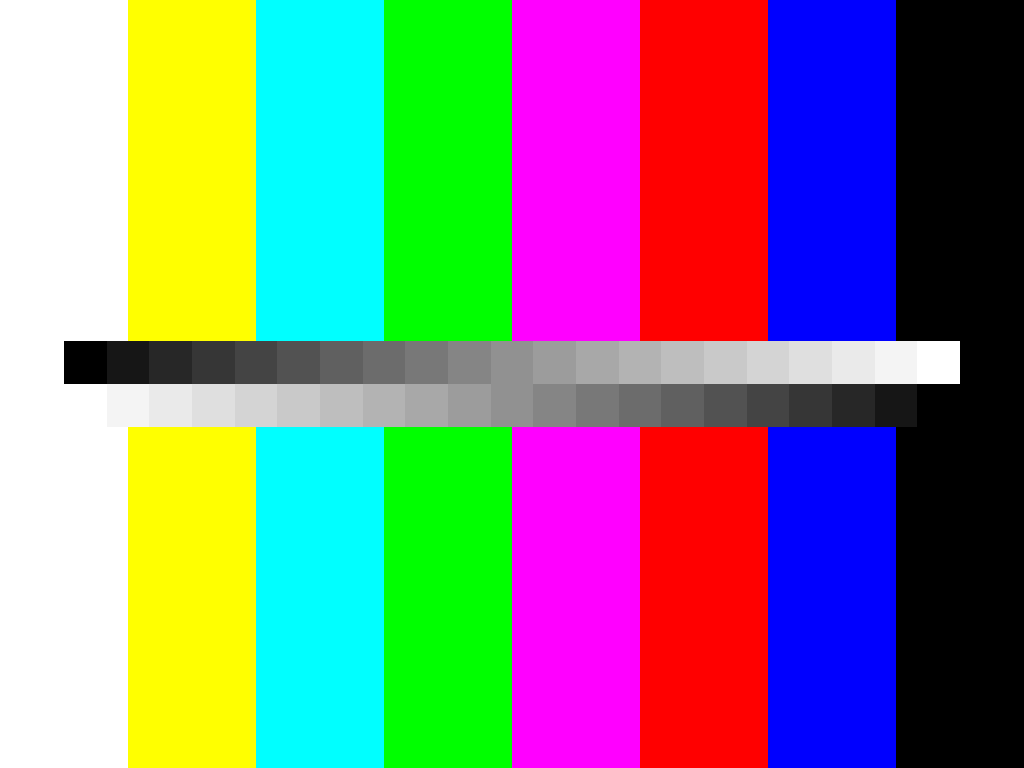
This file combines a grey scale with
electronically generated colour bars, just like the ones
used in television. The saturation of the light primary
colours - red, green and blue - is the maximum you can
generate in the computer: level 255. The light secondary
colours, which are also the pigment primaries - cyan,
magenta and yellow, are also at maximum saturation. White is
made up of equal and maximum amounts of all the light
primary colours. Black has zero amounts of the three
primaries. Here's how the colour bar colours are made
up:
The colour bars are useful as one of the
tests for colour printers, which convert RGB images to CMYK
- Cyan, Magenta, Yellow and Black. In colour printing, Black
is usually referred to as K (for "Key"), rather than B, to
avoid confusion with B for Blue.
You may be surprised how dull a print of
colour bars looks. Using four colour printing, blue
reproduces much darker than on a cathode ray tube. Green is
also on the dark side and there is little difference between
magenta and red. In colour printing, Red is made by adding
yellow to magenta.
THE REAL PICTURE
Finally, we bring you a real picture.
After all, that's what you will ultimately be looking at on
your system.
You should now be able to see the full
range of tones in this image. (This image was taken on a
Kodak DCS420 digital camera.)
The pictures which you see every month in
my "Chip Shop" column in "The Photographer" are judged on
monitors lined up in exactly the same way I have recommended
here. In a future feature we will describe other methods to
get still closer to perfection.
-
John Henshall
|