A shattered 1908 colour transparency on a glass plate is brought back to life - digitally
by John Henshall
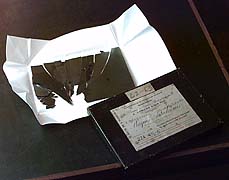
Coburn's 1908 plate as it is today.
On the 1st November 1908, Alvin Langdon Coburn (1882-1966),
a British photographer born in America, used one of the new 6.5 x 4.75 inch
Autochrome single exposure colour plates, made by Lumière and Sons
in France, to make a self-portrait.
The Royal Photographic Society, in Bath, has an extensive collection of
over 100,000 photographic images: from heliogravures to holograms, from
Daguerreotypes to digitised images. This magnificent collection has been
built up over a hundred years and covers the whole evolution of photography
and the variety of photographic processes, illustrated by the work of such
early pioneers as Talbot, Fenton, Cameron and Robinson. There are modern
classics by Weston, Adams, Karsh and a steadily growing emphasis on the
work of contemporary photographers. Material by the Seccessionist photographers,
Coburn, Steichen and Steiglitz is strong, as is the history of early colour
photography.
It is not really surprising that Coburn's Autochrome self-portrait found
its way into the Royal Photographic Society's collection. What is surprising
is that it lay there, broken into more than twenty pieces, for many years.
A seemingly hopeless case, in other collections it would probably have been
consigned to the waste bin.
Pam Roberts is the conscientious Curator of the RPS Collection who has maintained
a constant search for a process which could reconstruct her precious Coburn
Autochrome. She approached me to find a solution to the restoration using
digital imaging.
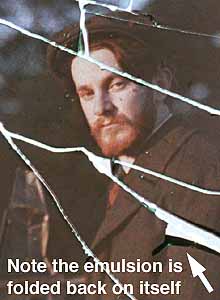
The first task was to complete the jigsaw puzzle, assembling the twenty
or so pieces of the glass plate in their correct relative positions on a
lightbox. With the emulsion lifting away from the plate, this was a tricky
task. I re-photographed the plate onto Ektar 25 film, using a Nikon F4 fitted
with 55mm Micro-Nikkor lens above the lightbox.
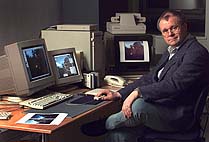
After processing the negative was digitised into a computer positive, using
a Kodak Professional RFS2035 Film Scanner to import the 18Mb file into an
Apple Macintosh Quadra 950 computer running the new Adobe Photoshop 2.5
program. Although the Autochrome was very dense and had faded to pink, it
was possible to correct the exposure and colour balance during the scanning
in the RFS2035, leaving only minor changes to be made during retouching.
The new version of Photoshop was perfect for the restoration. It has a wide
selection of "brushes", both hard and soft, as well as new "dodge"
and "burn" functions already very familiar to darkroom workers.
The gaps were filled by "cloning" the adjacent picture information
into them using Photoshop's "rubber stamp" tool. This process
is easier in places which have more texture, more difficult in the sky.
Nothing was drawn: every part of the restored Autochrome was present in
the original - though not necessarily in quite the same places! A very broad
(600 pixel diameter) custom soft brush worked extremely well for burning-in,
if a little slowly even with 64Mb of random access memory (RAM) in the workstation.
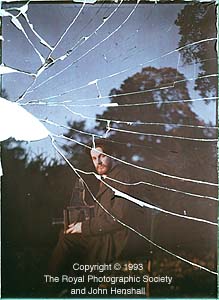
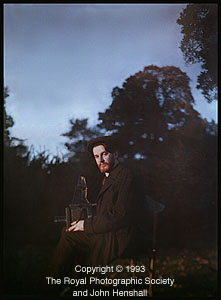
The images were scaled to be the same size (6.5 x 4.75 inches) as the
original plate and printed using a Kodak XL77000 dye sublimation printer,
driven direct from the Macintosh computer. They are reproduced here direct
from the original computer files.
In a photographic world which fears that electronics may replace our familiar
processes, isn't it appropriate that digital imaging should give such a
dramatic new lease of life to this pioneering photographer and an important
early photographic process?
 website.
