AGFA's CristalRaster
John Henshall reports on how "The Photographer" magazine's front covers are produced using Agfa's brand new hardware and software systems.
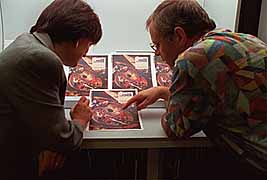
Liz Harding and John Henshall check the Agfaproof System
II proofs of the separations for "The Photographer" August 1994
cover.
Take another look at our front cover.
Take out your loupe and look at it more closely. There are no printing dots,
no moiré patterns, no rosettes, no loss of detail. All you can see
is a fine grain, reminiscent of the grain in photographic emulsion.
What you are looking at is a new system of printing which is set to change
the way images are reproduced on the printed page, bringing photographic
quality to reprographic printing. The system is Agfa's CristalRaster Technology
and The Photographer has been using it for front covers for the last four
months.
Below: The transparency ready to be scanned in
the SelectScan
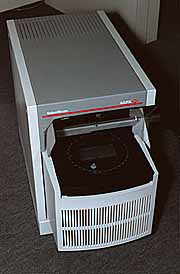 This month's
cover is a beautiful 4 x 5 inch transparency by
Brian Spranklen of Avalon Studios in Manchester. (Unfortunately, it
is not possible to show CrystalRaster's quality on the Internet!) It has
both lustrous deep shadows and bright highlights which come close to clear
emulsion. The colour is rich, the detail fine. Brian is one of the country's
most creative advertising photographers and he has used the wonderfully
wide range of Fuji Velvia film to the maximum creative effect here. In short,
this transparency is a nightmare to scan and reproduce on the printed page.
And that's exactly why we chose it.
This month's
cover is a beautiful 4 x 5 inch transparency by
Brian Spranklen of Avalon Studios in Manchester. (Unfortunately, it
is not possible to show CrystalRaster's quality on the Internet!) It has
both lustrous deep shadows and bright highlights which come close to clear
emulsion. The colour is rich, the detail fine. Brian is one of the country's
most creative advertising photographers and he has used the wonderfully
wide range of Fuji Velvia film to the maximum creative effect here. In short,
this transparency is a nightmare to scan and reproduce on the printed page.
And that's exactly why we chose it.
Brian's cover picture is the first to be scanned on Agfa's new SelectScan
high quality scanner, which has a density range of 3.6D and a maximum density
of 3.9. "With a 6000 element CCD that delivers scanning resolutions
up to 4000 pixels per inch, 16 bit A to D convertor achieving image sampling
at 13 bits per colour [9,192 levels], SelectScan captures the most subtle
detail - even in the heaviest shadows," claims Agfa. Good, let's put
it to the test!
Agfa is noted for flatbed colour scanners
- and the software which makes them special. They start with the desktop
StudioScan at around £1,000 including Adobe Photoshop LE. and go via
the Arcus Plus and Horizon Plus right up to the big daddy of them all, the
new SelectScan at £28,692. SelectScan will accommodate negatives and
transparencies from 35mm to 8 x 10 inches and reflective prints up to A4.
Flatbed scanners such as this are more kind to photographic originals than
drum scanners, for they do not require the precious originals to be subjected
to the peril of being taped to a spinning drum.
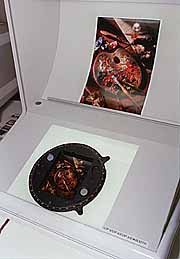
4 x 5 inch transparency mounted in the SelectScan carrier
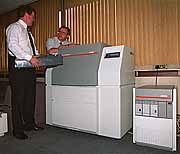
Victor Runacre takes the exposed film from the Agfa SelectSet
Avantra imagesetter for processing. The CristalRaster RIP is on the right.
SelectScan is not available until September.
It is so new that there is only one in the UK at the moment and only one
man who can 'drive' it to the full: Victor Runacre. Agfa attach a great
deal of importance to product training through the Agfa Academy and Victor
is one of the key people in Agfa's Brentford showroom, which is presently
undergoing a £750,000 re-fit. After scanning and separation, the resultant
CMYK digital image file was combined with our masthead in the QuarkXPress
page makeup program and sent via an Agfa PostScript RIP with CristalRaster
software to an Agfa SelectSet Avantra imagesetter. Here, the cover was 'written'
back to four pieces of film, from which the printing plates are made by
our printers, Hi-Tech Print, in Dinnington, South Yorkshire.
Before being sent to Hi-Tec, a proof was produced using AgfaProof System
II, which has the highest resolution of any proofing system and is thus
ideal for proofing the fine grain structure of CristalRaster and other stochastic
screens.
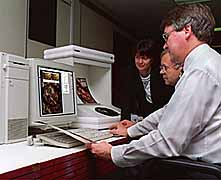
Liz Harding and John Henshall look on as Victor Runacre
aquires the scan of Brian Spranklen's image from the new Agfa SelectScan.
Photography by Barnaby Cox LRPS.
CristalRaster is the technique you should
now be turning to for brochures, portfolios, exhibition catalogues and advertisements
which demand the highest quality reproduction of photographs. And when you
do, please bear in mind that this superb high quality technique has been
made possible by the digital process.
Now who said digital is inferior?
This report first appeared as "Digital
Imaging in Action" in "The Photographer" magazine August
1994.
IMPORTANT NOTICE
This document is Copyright © 1996 John Henshall. All rights reserved.
This material may only be downloaded for personal non-commercial use. Please
safeguard the future of online publishing by respecting this copyright and
the rights of all other authors of material on the Internet.

